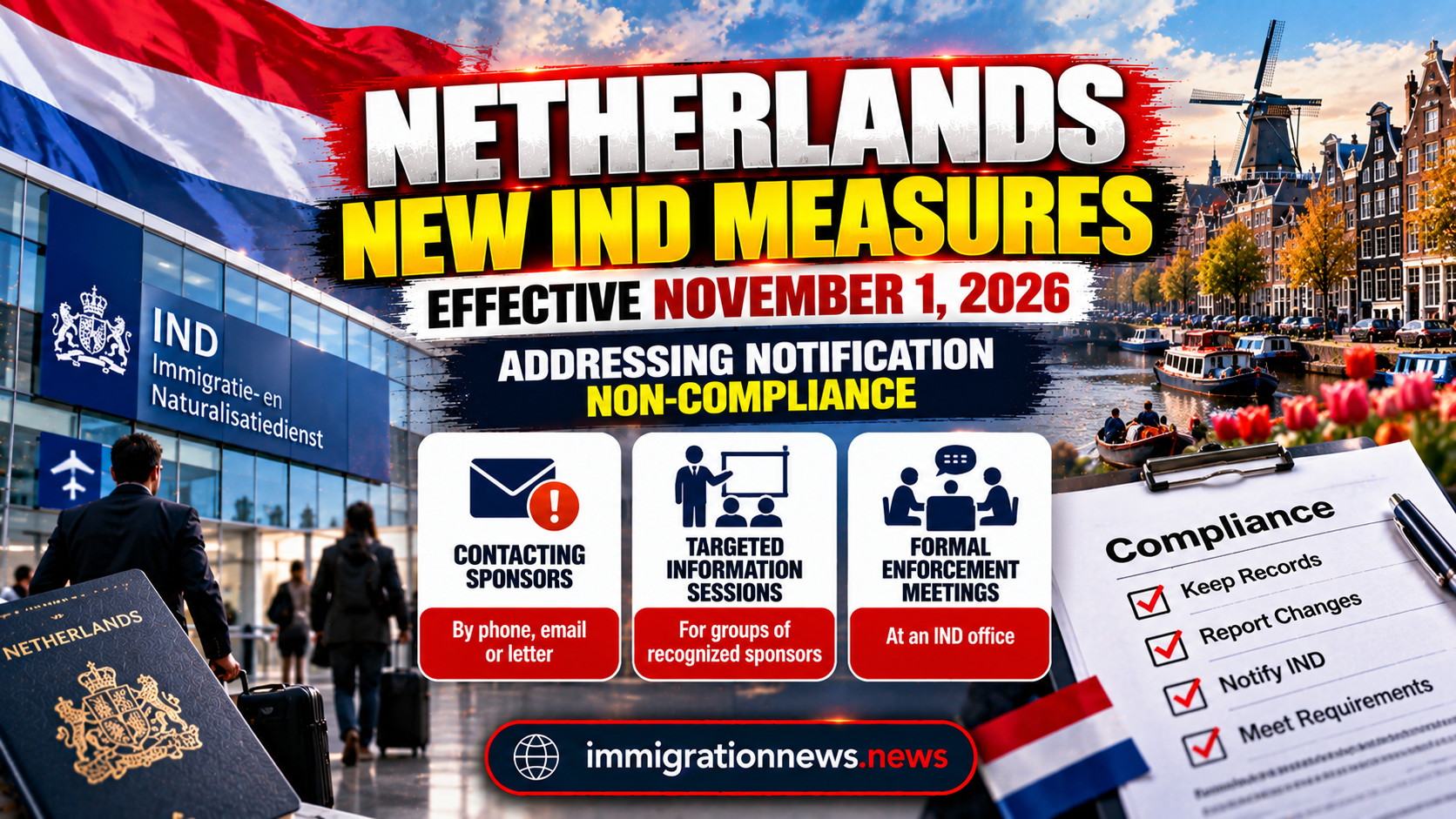
The Netherlands is introducing a new approach to immigration compliance from November 1, 2026, giving the Dutch Immigration and Naturalisation Service (IND) additional ways to address certain reporting and record-keeping failures by recognised sponsors. Instead of immediately relying on traditional enforcement measures such as warnings and administrative fines in every eligible case, the IND will be able to contact organisations, conduct targeted information sessions or invite sponsors to formal enforcement meetings.
The Netherlands IND enforcement measures 2026 will apply to specific breaches of two existing legal obligations: the duty to keep and retain records and the obligation to provide information about foreign nationals sponsored by an organisation. The changes are intended to encourage sponsors to correct mistakes and improve compliance, rather than automatically escalating every qualifying administrative failure to conventional enforcement.
However, the new approach does not remove sponsors’ legal responsibilities or guarantee that organisations will avoid penalties. If a sponsor fails to demonstrate a willingness to correct non-compliance, the IND can apply its standard fine policy. Serious cases involving fraud, abuse or breaches of the duty of care will continue to be handled through traditional enforcement measures.
The initiative will initially operate as a one-year pilot. Here is what employers, universities and other recognised sponsors need to know about the new Dutch immigration compliance framework.
What Are the Netherlands IND Enforcement Measures 2026?
The new measures introduce three alternative responses to certain instances of non-compliance by recognised sponsors.
From November 1, 2026, the IND may choose to:
- Contact a recognised sponsor by telephone, email or letter to address a compliance issue.
- Organise targeted information sessions for groups of recognised sponsors.
- Invite a recognised sponsor to a formal enforcement meeting at an IND office.
These measures are alternatives to traditional enforcement in qualifying cases. They are intended to help organisations understand their obligations, correct shortcomings and reduce the risk of repeated violations.
The Netherlands IND enforcement measures 2026 do not establish a general amnesty for employers or educational institutions. The underlying legal obligations remain in force, and the IND retains its authority to impose fines where appropriate.
The choice of response will depend on the type of violation, whether it falls within the pilot’s scope, whether similar violations have occurred repeatedly and whether the sponsor is willing to resolve the problem.
Which Organisations Are Affected by the New Rules?
The changes concern organisations recognised by the IND as immigration sponsors. These organisations play an important role in helping eligible foreign nationals obtain or maintain residence rights in the Netherlands.
Recognised sponsors can include employers recruiting highly skilled migrants, qualifying research organisations and educational institutions sponsoring international students. Other recognised sponsor categories exist under the Dutch immigration system.
Recognition allows organisations to participate in specific immigration procedures, but it also brings legal responsibilities. Sponsors must monitor relevant changes, maintain records and ensure they comply with the obligations associated with their sponsorship status.
The Netherlands IND enforcement measures 2026 are particularly relevant to organisations managing multiple international employees or students, because changes in employment, study arrangements and residence permits can create recurring reporting responsibilities.
Organisations should not assume that the new pilot applies to every type of sponsor or every possible immigration violation. The announced measures specifically concern breaches of the administrative and information obligations.
1. Failure to Notify Changes to Record-Keeping Locations
Recognised sponsors must maintain records relating to the foreign nationals they sponsor. They must also notify the IND when the location of their administrative records changes, in accordance with the applicable reporting requirements.
For example, an organisation might relocate its administrative office, change the location where immigration records are retained or restructure its internal record-management arrangements.
If the sponsor fails to report the relevant change, the IND may respond through one of the new measures where the violation falls within the pilot’s scope.
The purpose is to improve compliance and ensure the IND can obtain relevant documents when required. Keeping accurate and accessible records is essential when authorities need to verify whether an organisation has fulfilled its sponsorship obligations.
Sponsors should review their internal procedures to ensure the relevant department informs the immigration compliance team whenever record locations or administrative arrangements change.
2. Failure to Report Employment and Residence Changes
The new approach also covers certain failures to notify the IND about changes affecting a sponsored foreign national.
These include specified situations involving employment transfers, the relationship between an employment or study arrangement and a residence permit, and changes in residence status.
Employee transfers within the same corporate group
A reporting failure may arise when an employee transfers to another entity within the same corporate group and the receiving entity is also a recognised sponsor.
Although the companies may belong to the same group, they are separate legal entities. Employers should therefore check whether the transfer requires notification and ensure that responsibility for the employee’s immigration status is properly documented.
Employment or study arrangements ending alongside a residence permit
The pilot also covers certain failures to notify the IND when an employment contract or course of study ends simultaneously with the residence permit.
Sponsors should carefully track employment end dates, student enrolment changes and residence permit validity. Relevant changes must be reported according to the rules applicable to the particular residence category.
Residence permits that have expired or will expire soon
Another covered situation concerns a foreign national whose residence permit has already expired or is due to expire within four weeks.
Sponsors should not wait until a permit expires before reviewing their reporting responsibilities. Immigration teams should maintain a reliable system for tracking permit expiry dates and identifying changes that need to be reported.
Foreign nationals receiving a different residence permit
The pilot also covers certain failures to notify the IND when a foreign national has already received a residence permit under a different restriction or residence purpose.
A change in residence category can affect the basis on which the person is permitted to stay in the Netherlands and the responsibilities of the original sponsor. Organisations should confirm whether they must report the change rather than assuming that the new permit automatically resolves all outstanding notification duties.
Under the Netherlands IND enforcement measures 2026, contacting a sponsor or providing targeted information may be appropriate for these specified reporting failures.
3. When Can the IND Hold a Formal Enforcement Meeting?
The IND may invite a recognised sponsor to a formal enforcement meeting when the infringement does not fall within the categories intended for simple contact or targeted information sessions.
A formal meeting may also be used when the specified types of infringement occur more than twice in a year.
This distinction means that repeated reporting failures can receive a more direct response, even if each individual incident might otherwise qualify for a less formal intervention.
A meeting at an IND office gives the authority an opportunity to address the compliance issue with the sponsor. It also gives the organisation an opportunity to explain the circumstances, demonstrate corrective action and establish how similar problems will be prevented.
Sponsors should treat such invitations seriously. They should review the relevant records, identify the cause of the failure and prepare evidence of any remedial measures already taken.
The Netherlands IND enforcement measures 2026 therefore combine educational interventions with a more formal mechanism for cases requiring additional attention.
Will Recognised Sponsors Still Face Fines?
Yes. The pilot does not eliminate the possibility of administrative fines.
If a recognised sponsor does not demonstrate a willingness to correct the non-compliance, the IND will apply its standard fine policy where appropriate.
For example, an organisation that repeatedly fails to notify the IND about relevant changes, ignores requests to address a reporting problem or refuses to improve its record-keeping procedures may face conventional enforcement.
The new approach is intended to encourage compliance, not allow organisations to disregard their responsibilities.
Sponsors should also understand that different enforcement consequences may apply depending on the nature and seriousness of the violation. The pilot does not mean that every eligible violation will necessarily receive an informal response first.
Organisations should therefore continue to follow the existing legal requirements and maintain documented procedures for reporting changes, retaining records and reviewing compliance.
Serious Violations Will Continue to Face Traditional Enforcement
The IND has made clear that very serious transgressions will remain outside the alternative approach.
Cases involving fraud, abuse or breaches of the duty of care will continue to be addressed through traditional enforcement measures.
The duty of care is distinct from the two obligations covered by the pilot. It includes responsibilities relating to the careful recruitment and selection of foreign nationals and, where applicable, informing them about the requirements governing admission and residence.
A recognised sponsor cannot rely on the new pilot to avoid the consequences of serious misconduct or neglect of its duty of care.
The Netherlands IND enforcement measures 2026 are therefore narrowly targeted at certain administrative and reporting failures, rather than a broad relaxation of immigration enforcement.
What Should Employers and Universities Do Before November 1?
Organisations sponsoring foreign workers, researchers and international students should use the introduction of the pilot as an opportunity to review their internal compliance systems.
Practical steps include:
- Audit reporting procedures: Confirm which changes must be reported, who is responsible for submitting notifications and how deadlines are monitored.
- Review permit expiry dates: Maintain a reliable record of residence permit validity and flag permits approaching expiry.
- Check corporate transfers: Ensure that transfers between related entities are assessed for immigration reporting requirements.
- Improve record retention: Keep the required documents organised and accessible for the legally prescribed retention period.
- Train relevant staff: Make sure HR, payroll, recruitment, university administration and immigration teams understand their responsibilities.
- Document corrective action: Record identified mistakes, their causes and the steps taken to prevent recurrence.
The IND’s existing sponsor guidance explains that relevant records generally need to be retained until five years after the organisation is no longer the foreign national’s sponsor. Specific record requirements depend on the type of sponsored foreign national.
Organisations can also consult the IND’s public register to check recognised sponsor status and review the authority’s published guidance on sponsor obligations.
Preparing before the effective date can help organisations respond more effectively if the IND contacts them about a compliance issue.
How Long Will the New Pilot Last?
The new enforcement approach will operate for one year, beginning November 1, 2026.
After the pilot period, the IND will evaluate how the measures have worked and decide whether the programme should continue. The authority may also determine that changes are necessary before extending or modifying the approach.
The evaluation means that the arrangements should not automatically be treated as a permanent change to Dutch immigration enforcement policy.
Employers and educational institutions should monitor official IND announcements for information about the pilot’s outcome, any changes to its scope and further guidance on the treatment of recognised sponsors.
Until further decisions are announced, the existing reporting, record-keeping and duty-of-care obligations remain important parts of the Dutch immigration framework.
FAQs : Netherlands IND Enforcement Measures 2026
1. When do the Netherlands IND Enforcement Measures 2026 begin?
The pilot is scheduled to begin on November 1, 2026, and will initially run for one year.
2. Which violations are covered by the pilot ?
The pilot covers certain violations of the duty to keep and retain records and the obligation to provide information. It includes specified failures involving record locations, employee transfers, employment or study changes and residence permit status.
3. Can the IND still impose fines?
Yes. If a sponsor does not demonstrate a willingness to correct the non-compliance, the IND will apply its standard fine policy where appropriate. Serious violations remain subject to traditional enforcement.
4. Does the pilot apply to every immigration sponsor violation?
No. It is limited to specified administrative and reporting failures. Serious matters involving fraud, abuse or breaches of the duty of care are excluded from the alternative approach.
5. What happens after the one-year pilot?
The IND will evaluate the programme and decide whether to continue it and whether any changes are necessary.
Final Takeaway On Netherlands IND Enforcement Measures 2026
Under the Netherlands IND Enforcement Measures 2026, Netherlands is introducing a more flexible approach to certain sponsor compliance failures from November 1, 2026. The IND will be able to contact recognised sponsors, arrange targeted information sessions or hold formal enforcement meetings instead of relying exclusively on conventional enforcement measures in qualifying cases.
However, organisations must continue meeting their legal reporting and record-keeping responsibilities. Repeated violations, unwillingness to correct problems and serious misconduct can still result in traditional enforcement, including fines where applicable.
Employers, universities and other recognised sponsors should review their compliance procedures now, train relevant staff and ensure that changes affecting foreign nationals are reported accurately and on time.
For the latest international immigration developments, policy updates and employer guidance, follow immigrationnews.news.
Source : Fragomen
Read About : Limoges Town Hall Fire 2026 : Historic French Landmark Destroyed Amid Protests as JD Vance Blames Immigration