

Canada could increase immigration levels after two years of tighter admission policies, with Immigration Minister Lena Metlege Diab signalling that the federal government may need more newcomers to support economic growth, fill labour shortages and respond to an ageing population.
Speaking at a press conference in Kitchener, Ontario, on October 16, 2026, Diab pointed to Canada’s slowest annual population growth in decades and argued that the country would continue to need international workers to support its economic ambitions.
Her comments have renewed attention on Canada immigration levels 2027, particularly among prospective permanent residents, international students, temporary foreign workers and Canadian employers.
However, the government has not officially announced an increase in immigration targets. The existing 2026–2028 Immigration Levels Plan continues to set annual permanent resident admissions at 380,000, while targets for new temporary resident arrivals remain substantially below the levels seen during the post-pandemic period.
The next Immigration Levels Plan, covering 2027–2029, is expected in November 2026. It will determine whether the government’s latest comments translate into higher admission targets or a more gradual adjustment to Canada’s immigration strategy.
What Did Canada’s Immigration Minister Say on October 16?
Immigration Minister Lena Metlege Diab indicated that the recent reductions in immigration cannot necessarily continue indefinitely if Canada wants to achieve its economic objectives.
Speaking in Kitchener, Diab highlighted the country’s unusually slow population growth and the need for workers from abroad to fill positions that cannot readily be filled domestically.
She said Canada had experienced its slowest population increase since the Second World War and emphasised that the government had an ambitious economic agenda.
Diab also argued that Canada would need international workers to address labour shortages over the coming decade.
Her remarks came amid questions about whether immigration should increase despite continuing concerns about housing affordability, access to public services and employment opportunities for Canadians.
The minister defended the government’s approach to housing and referred to falling asking rents, while pointing to homebuilding and other affordability measures.
However, she did not announce a new immigration target or specify which categories would receive additional admissions.
For people following Canada immigration levels 2027, this distinction is crucial. The minister’s comments indicate a possible change in policy direction, but they do not establish that permanent resident admissions, international student permits or temporary foreign worker arrivals will increase.
The official plan will provide the more definitive answer.
What Are Canada’s Current Immigration Targets?
Canada’s existing 2026–2028 Immigration Levels Plan was designed to stabilise permanent resident admissions while reducing the number of new temporary residents entering the country.
Under the published plan, the main targets are:
| Immigration category | 2026 | 2027 | 2028 |
|---|---|---|---|
| Permanent resident admissions | 380,000 | 380,000 | 380,000 |
| New temporary resident arrivals | 385,000 | 370,000 | 370,000 |
| Federal High Skilled, including Express Entry | 109,000 | 111,000 | 111,000 |
| Provincial Nominee Program | 91,500 | 92,500 | 92,500 |
| Family reunification | 84,000 | 81,000 | 81,000 |
| Temporary Foreign Worker Program | 60,000 | 50,000 | 50,000 |
| International Mobility Program | 170,000 | 170,000 | 170,000 |
Source: Immigration, Refugees and Citizenship Canada’s 2026–2028 Immigration Levels Plan.
The plan represents a substantial reduction from the earlier ambition to welcome 500,000 permanent residents annually by 2025.
It also lowers targets for new temporary residents, including international students and temporary foreign workers, as the government attempts to ease pressure on housing, infrastructure and public services.
The current plan places a greater emphasis on economic immigration, with a significant proportion of permanent resident admissions allocated to economic categories.
These figures remain the official targets unless the government formally revises them.
The next announcement on Canada immigration levels 2027 could therefore clarify whether Ottawa intends to increase permanent resident admissions, adjust temporary resident targets or maintain the existing approach while making changes to specific programmes.
Why Is Canada Considering More Immigration?
Canada’s population slowdown is a central part of the government’s argument for potentially changing direction.
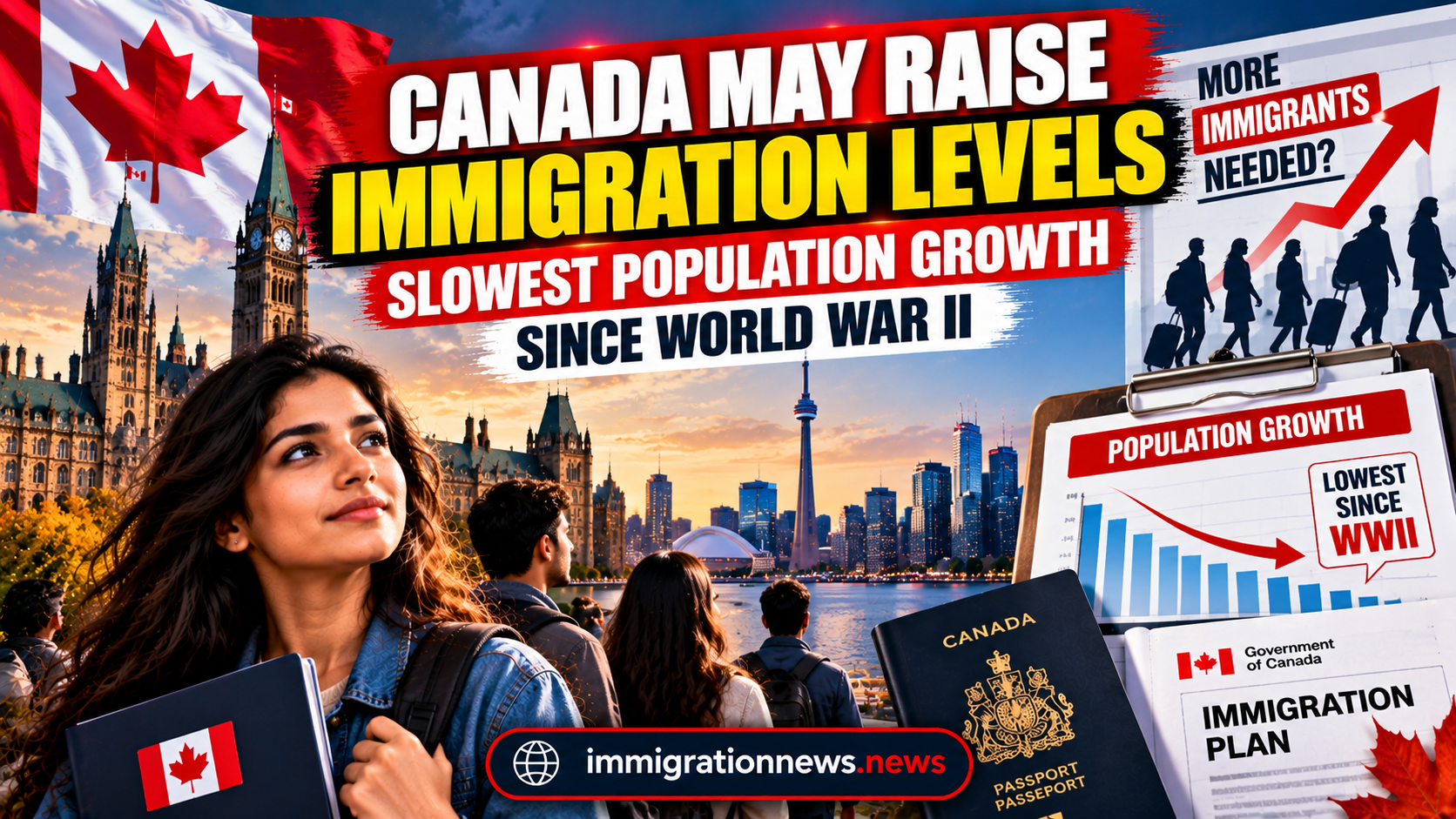
According to Statistics Canada’s population estimates released on September 23, 2026, the country’s population reached 41,798,407 on July 1, 2026.
That represented an annual increase of 189,425 people, or approximately 0.5%, compared with July 1, 2025.
Statistics Canada said this was the lowest annual July-to-July population growth in absolute terms since 1944–1945 and the lowest percentage growth since 1915–1916.
The slowdown followed several years of unusually rapid population growth.
| Period | Approximate annual population growth rate |
|---|---|
| July 2021–July 2022 | 1.8% |
| July 2022–July 2023 | 2.7% |
| July 2023–July 2024 | 2.8% |
| July 2024–July 2025 | 1.1% |
| July 2025–July 2026 | 0.5% |
The rapid changes in population growth have been driven largely by international migration, including changes in the number of temporary residents and permanent immigrants entering Canada.
The government reduced temporary resident admissions after concerns grew about housing affordability and pressure on services. The latest population data show that those measures have coincided with a significant slowdown in overall population growth.
For policymakers, the challenge is determining how to maintain sustainable immigration levels without undermining Canada’s economic and demographic needs.
How Could an Ageing Population Affect Immigration Policy?
Canada’s demographic profile is another factor behind the renewed discussion.
Statistics Canada reported that the country’s median age reached 40.9 years on July 1, 2026, while the average age reached 42.1 years.
An ageing population can increase demand for healthcare and other services while gradually reducing the proportion of people in their prime working years.
Canada’s fertility rate is also well below the level generally associated with replacing the population without immigration over the long term.
Immigration can help expand the workforce, support businesses and contribute to tax revenues used to finance public services. It can also help address shortages in occupations where employers struggle to recruit sufficient workers.
Healthcare, construction, skilled trades and technology are among the sectors where employers may need specialised skills and additional workers.
However, immigration is not a complete solution to demographic challenges. Newcomers also need housing, access to services and opportunities to participate in the labour market.
The policy challenge is therefore not simply deciding whether Canada should welcome more people. It is determining how many newcomers the country can accommodate, which skills are needed and how to ensure that population growth is matched by infrastructure and employment opportunities.
Why Is Increasing Immigration Politically Difficult?
Despite the demographic arguments for immigration, the government faces significant economic and political constraints.
Rapid population growth between 2022 and 2024 intensified public debate over housing availability, rental costs, healthcare access and the capacity of schools and other services.
Critics argue that immigration increased faster than Canada’s ability to build housing and expand infrastructure. They also point to unemployment and difficulties faced by younger Canadians entering the labour market.
These concerns contributed to the federal government’s decision to reduce temporary resident targets and stabilise permanent resident admissions.
The latest discussion about Canada immigration levels 2027 therefore comes at a sensitive moment.
A higher immigration target could help employers recruit workers and support long-term economic growth, but it could also face public opposition if housing supply, job creation and public services fail to keep pace.
The government will need to explain how any increase would be managed and why the proposed targets are appropriate for Canada’s economic conditions.
A controlled adjustment would differ from the rapid population expansion experienced earlier in the decade. The minister’s comments suggest that the government is considering the balance between demographic needs and the practical limits of absorbing newcomers.
Could Canada Increase Permanent Resident Targets in 2027?
An increase in permanent resident admissions is one possible outcome of the upcoming Immigration Levels Plan, but no new figure has been confirmed.
The existing target is 380,000 permanent residents annually in 2026, 2027 and 2028. Diab’s remarks suggest the government may reconsider that trajectory, but she did not specify whether admissions would rise above 380,000 or when any increase might begin.
Prime Minister Mark Carney had also indicated in September 2026 that the government could consider a controlled population increase once the immigration system was operating sustainably.
Taken together, the comments suggest that Ottawa is reviewing its approach rather than announcing an immediate return to the previous 500,000-per-year target.
For permanent resident applicants, the actual effect will depend on how the new plan allocates admissions among economic immigration, family reunification, refugees and other categories.
A higher overall target would not automatically guarantee additional invitations for every applicant group.
The distribution of places, selection criteria and labour-market priorities will remain important.
What Could Higher Immigration Targets Mean for Express Entry Applicants?
Express Entry candidates will be watching the next plan closely because federal economic immigration targets influence the number of permanent residence invitations that may be issued over time.
The existing plan sets the Federal High Skilled target at 111,000 for both 2027 and 2028.
If the government increases this allocation, it could create room for additional invitations through Express Entry, depending on the distribution of admissions, application processing and other programme requirements.
However, a higher target would not automatically mean that Comprehensive Ranking System (CRS) cut-off scores fall.
CRS thresholds depend on the number and profiles of candidates in the pool, the type of draw, category-based selection priorities and the number of invitations issued in each round.
Changes to selection rules can also affect how candidates compete for invitations.
Applicants should therefore avoid making decisions based on an assumed future CRS cut-off. They should continue improving their eligibility where possible, monitor official announcements and assess their options under the rules currently in effect.
The Canada immigration levels 2027 announcement will provide important context for the future scale of economic immigration, but individual outcomes will depend on the final programme allocations and selection policies.
Will International Students and Temporary Foreign Workers Benefit?
There is currently no confirmation that Canada will increase international student or temporary foreign worker arrivals.
The existing plan sets a target of 155,000 new international student arrivals in 2026 and 150,000 in each of 2027 and 2028. Temporary resident arrivals overall are targeted at 370,000 in both 2027 and 2028.
The government has also committed to reducing the share of temporary residents to below 5% of Canada’s population by the end of 2027.
Diab did not specify whether her comments about potentially increasing immigration referred to permanent residents, temporary residents or both.
Consequently, international students should not interpret the minister’s remarks as confirmation that study permit caps will rise. Temporary foreign workers should likewise not assume that more work permits will become available.
Any changes will depend on the new plan and subsequent programme-specific announcements.
For people considering studying or working in Canada, the safest approach is to review the current eligibility requirements, financial obligations and permit conditions before making commitments.
When Will Canada Announce the 2027–2029 Immigration Levels Plan?
The federal government is expected to announce the 2027–2029 Immigration Levels Plan in November 2026.
The plan will establish targets for permanent resident admissions and new temporary resident arrivals over the next three years.
It should clarify whether the government intends to increase permanent resident admissions above the current annual target of 380,000, maintain the existing approach or make more targeted changes to specific immigration categories.
The plan will also need to address the government’s commitments on temporary resident numbers and the balance between economic growth, labour-market needs, housing availability and public services.
Until the official announcement is published, any specific prediction about the number of immigrants Canada will admit in 2027 remains speculative.
Applicants, employers and educational institutions should follow updates from Immigration, Refugees and Citizenship Canada rather than relying on unconfirmed targets circulating online.
Final Takeaway On Canada Immigration Levels 2027
Canada may be reconsidering its immigration strategy as population growth slows and concerns grow about the country’s ageing workforce and long-term economic needs.
Immigration Minister Lena Metlege Diab’s October 16 comments indicate that the government is open to increasing immigration, but no new admission targets have been announced.
The upcoming Canada immigration levels 2027 plan will determine whether the government moves beyond the current permanent resident target of 380,000 annually or maintains its existing approach with more targeted adjustments.
For prospective immigrants, international students and temporary workers, the key message is to distinguish political signals from official policy. The November announcement will provide the clearest indication of Canada’s future immigration direction.
FAQs : Canada Immigration Levels 2027
1. Has Canada officially announced higher immigration targets for 2027?
No. Immigration Minister Lena Metlege Diab signalled on October 16, 2026, that immigration could increase, but she did not announce new figures. The current official permanent resident target for 2027 remains 380,000.
2. Why is Canada considering increasing immigration?
The government has pointed to slow population growth, an ageing population, economic ambitions and the need to fill labour shortages. It must also balance these needs against housing affordability and pressure on public services.
3. Will Canada increase Express Entry invitations in 2027?
It is possible if the government increases the Federal High Skilled allocation, but no additional invitation numbers have been confirmed. CRS cut-offs will depend on draw sizes, candidate profiles, selection categories and other programme rules.
4. Will international student and temporary worker numbers increase?
No increase has been confirmed. The minister did not specify whether the possible change would apply to permanent residents, temporary residents or both. The new plan is expected to clarify the government’s direction.
5. When will Canada announce its next Immigration Levels Plan?
The 2027–2029 Immigration Levels Plan is expected in November 2026. It will set the government’s targets for permanent resident admissions and temporary resident arrivals for the coming years.
Source : Immigration News Canada
Read About : Alberta Referendum Immigration Limits: Voters Reject Separation but Demand Tougher Rules In 2026

One thought on “Canada Immigration Levels 2027: Government Signals Possible Increase as Population Growth Hits Historic Low”