
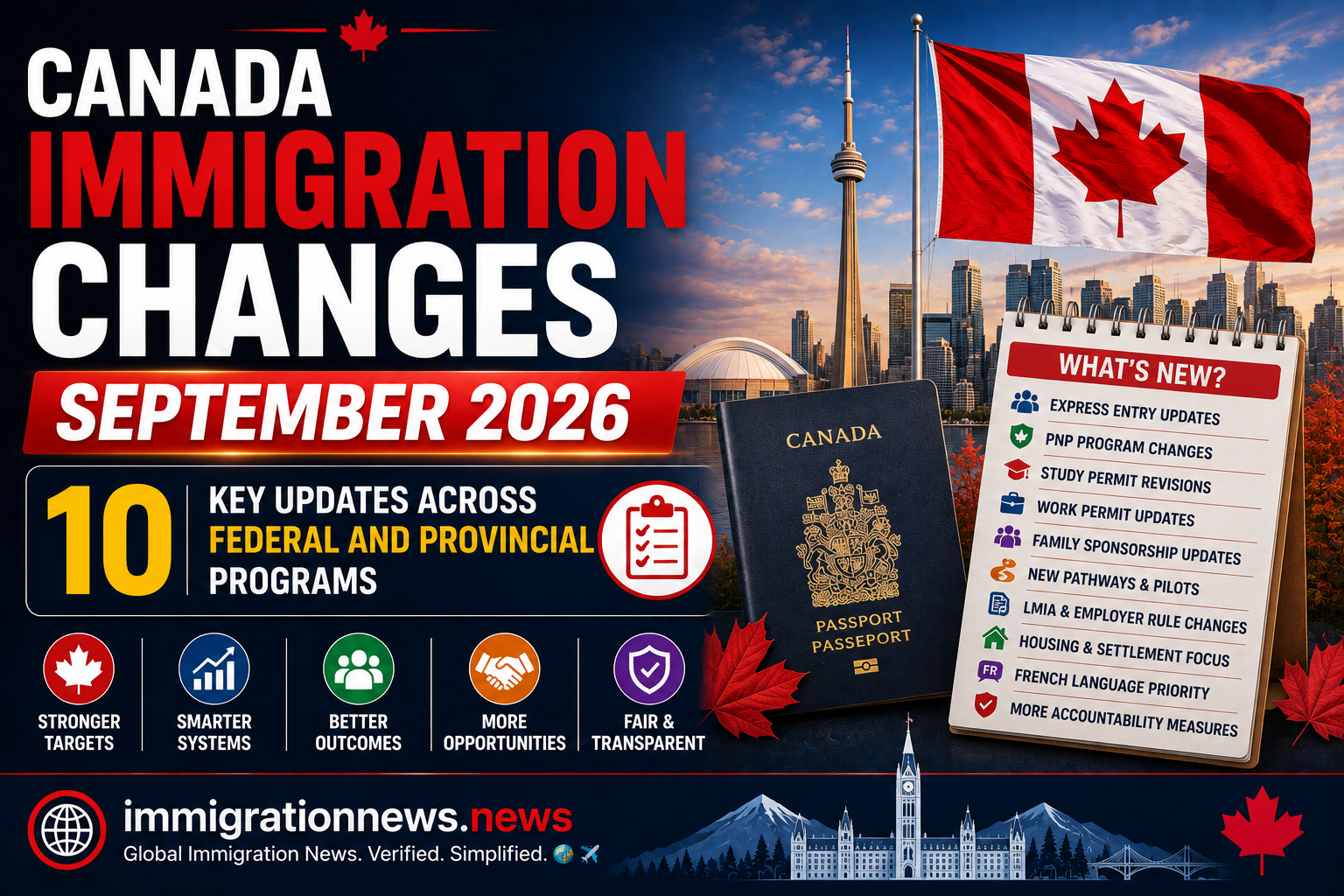
September 2026 brings a sweeping slate of Canada immigration changes September 2026 that touch nearly every category of applicant, from international students and temporary foreign workers to permanent residence seekers and employers. Immigration, Refugees and Citizenship Canada is moving ahead with compliance investigations targeting higher-risk study permit extension cases while implementing a centralized Letter of Acceptance fraud-detection function.
At the provincial level, Nova Scotia introduces application fees for the first time, Manitoba makes a new employer-registration form mandatory, and Saskatchewan opens one of its two remaining capped-sector intake windows. Here is a complete breakdown of every confirmed development.
Quick Highlights : Canada Immigration Changes September 2026
- Canada immigration changes September 2026 include a higher study permit proof-of-funds threshold of $23,448
- Hong Kong permanent residence pathways stopped accepting new applications after August 31
- IRCC is launching compliance investigations targeting former Student Direct Stream study permit extensions
- Nova Scotia introduces new PNP application fees of $1,000 (worker) and $2,000 (entrepreneur) starting September 1
- Manitoba’s mandatory new TFW employer-registration form takes effect September 16
- Saskatchewan’s next capped-sector SINP intake opens September 14
- Canada extended Ebola-related immigration and travel restrictions until September 28
1. IRCC Begins Higher-Risk Study Permit Compliance Investigations
Among the most significant Canada immigration changes September 2026, IRCC’s official action plan presented to the Standing Committee on Citizenship and Immigration outlines a timeline for launching compliance investigations on study permit extension applications identified as higher risk—specifically those originally processed under the now-cancelled Student Direct Stream (SDS), which ended November 8, 2024.
A 2026 audit linked the former SDS to a disproportionate share of confirmed fraud cases. IRCC was scheduled to identify investigation volumes by June 2026 and launch investigations by September 2026, using an advanced analytics model to triage applications by risk. Separately, the department is implementing a centralized Letter of Acceptance verification function, issuing procedural fairness letters where verification returns a “no match” result—potentially leading to misrepresentation findings. IRCC has entered over 1,274 information alerts on immigration files, with case reviews scheduled for completion by September 2026.
2. Study Permit Proof-of-Funds Increases
Among the Canada immigration changes September 2026 affecting nearly every prospective student, study permit applications submitted on or after September 1, 2026 face a higher minimum financial requirement.
| Family Size | Minimum Living Expense Requirement |
|---|---|
| 1 person | $23,448 |
| 2 people | $29,192 |
| 3 people | $35,888 |
| 4 people | $43,572 |
| 5 people | $49,419 |
| 6 people | $55,736 |
| 7 people | $62,054 |
This represents a $553 increase for a single applicant, tied to 75% of Statistics Canada’s Low-Income Cut-Off, recalculated annually. These amounts cover living expenses only, separate from tuition and travel costs. The submission date determines which threshold applies—applications before September 1 use the previous $22,895 figure.
3. Hong Kong Permanent Residence Pathways Closed
Canada’s special temporary PR pathways for eligible Hong Kong residents stopped accepting new applications after August 31, 2026, IRCC confirmed in a notice published August 28. Stream A (in-Canada graduates) and Stream B (Canadian work experience) were introduced in 2021 and expanded in 2023.
As of June 30, 2026, IRCC had received approximately 30,315 applications representing 48,560 people, with more than 8,600 applications approved. Applications submitted on or before August 31 continue processing normally. Applicants who filed before closure can apply for open work permits under a separate policy remaining in effect until May 2029.
4. Advanced LINC and CLIC Language Training Phased Out
Among the less publicized Canada immigration changes September 2026, IRCC has been scaling back Stage Two federally funded language instruction (CLB levels 5–8) under LINC and its French counterpart, CLIC. Federal Settlement Program resources are concentrating more heavily on Stage One foundational programming (CLB 1–4). Newcomers seeking advanced instruction will need to explore provincially funded programs, community college ESL offerings, or self-funded courses.
5. Manitoba Makes New TFW Employer Form Mandatory
As of September 16, 2026, Manitoba’s Employment Standards Division will no longer accept the previous employer-registration form under the Worker Recruitment and Protection Act. Employers recruiting temporary foreign workers must register and obtain a Certificate of Registration before recruiting internationally, including before applying for an LMIA. Non-compliance carries fines up to $25,000 for individuals and $50,000 for corporations.
6. Nova Scotia Introduces New PNP Application Fees
Among the most notable Canada immigration changes September 2026, Nova Scotia is introducing application fees for the Nova Scotia Nominee Program for the first time, effective September 1. Worker streams (Skilled Worker, Nova Scotia Graduate, Nova Scotia Express Entry) carry a $1,000 fee, while entrepreneur-stream applicants pay $2,000.
There is no fee to submit an Expression of Interest—fees apply only once an EOI is selected for assessment. Candidates who received their selection letter before September 1 are exempt from the new fee regardless of when their EOI was submitted.
7. Saskatchewan Opens Its Next Restricted SINP Intake
The Saskatchewan Immigrant Nominee Program has scheduled its next capped-sector intake window for September 14, 2026—one of only two remaining 2026 opportunities for employers and workers in accommodation and food services, retail trade, and trucking. Demand has been intense throughout 2026, with July’s intake filling all available position limits on opening day. Workers applying must hold a valid work permit with six months or less remaining before expiry. The final 2026 capped-sector intake follows on November 2.
8. West Kootenay, B.C. RCIP Opens Its Final 2026 Intake
The West Kootenay Rural Community Immigration Pilot opens its final scheduled 2026 intake September 2 at 10:00 a.m. Pacific Time, closing September 7 at 4:00 p.m. Applicants need a genuine, full-time, non-seasonal, permanent job offer from a designated employer in priority sectors including health, trades and transport, and manufacturing. Applications from the June pool not previously selected automatically carry forward into this final intake.
9. Northwest Territories Holds Its Final 2026 PNP Draw
The Northwest Territories Nominee Program has scheduled its final 2026 EOI draw under the Employer-Driven Stream for September 25, with candidates needing profiles submitted by September 22. This follows the territory’s allocation increase to 300 nominations in August, up from 197, after IRCC granted 103 additional spaces.
10. Canada Extends Ebola-Related Immigration and Travel Restrictions
Canada has extended existing Ebola-related border measures until September 28, 2026 at 11:59 p.m. EDT, the Public Health Agency of Canada confirmed August 28. The immigration-document suspension applies to foreign nationals listing the Democratic Republic of the Congo, Uganda, or South Sudan as their last country of residence. September 28 is only the currently scheduled expiry date—not a guarantee restrictions will lift.
Summary Table of September 2026 Changes
| Change | Effective Date | Who Is Affected |
|---|---|---|
| Study permit compliance investigations | By September 2026 | International students, DLIs |
| Study permit proof-of-funds increase | September 1, 2026 | All study permit applicants outside Quebec |
| Hong Kong PR pathways closed | After August 31, 2026 | Eligible Hong Kong residents |
| LINC/CLIC advanced training phase-out | By September 2026 | Newcomers seeking advanced language instruction |
| Manitoba mandatory TFW employer form | September 16, 2026 | Manitoba employers |
| Nova Scotia PNP application fees | September 1, 2026 | NSNP applicants |
| Saskatchewan capped-sector SINP intake | September 14, 2026 | Accommodation, retail, trucking sectors |
| West Kootenay RCIP final intake | September 2–7, 2026 | BC’s West Kootenay region |
| NWT final 2026 PNP draw | September 25, 2026 | Employer-Driven Stream candidates |
| Ebola restrictions extended | Until September 28, 2026 | DRC, Uganda, South Sudan-linked travellers |
What This Reflects Overall
Taken together, these Canada immigration changes September 2026 reveal several intersecting policy trends. Compliance and enforcement are tightening significantly in the student stream, with IRCC moving from audit findings to active investigations and centralized fraud detection. Financial requirements continue their steady annual upward adjustment. The closure of Hong Kong PR pathways marks the end of a five-year policy chapter, even as processing continues for those who filed before the deadline.
Provincial nominee programs are evolving in different directions simultaneously—Nova Scotia introducing fees to align with most other provinces, while Saskatchewan continues managing intense demand through tightly controlled intake windows.
Key Takeaways Of Canada Immigration Changes September 2026
September 2026 represents one of the busiest months of the year for Canada immigration changes September 2026, spanning federal compliance enforcement, financial threshold increases, provincial fee introductions, and the closure of a major humanitarian pathway. Applicants across every category—students, temporary foreign workers, provincial nominee candidates, and those connected to Hong Kong or affected African countries—should verify their eligibility against official sources before relevant deadlines pass.
FAQs : Canada Immigration Changes September 2026
What immigration changes take effect in Canada in September 2026?
Ten confirmed developments span study permit compliance investigations, a higher proof-of-funds requirement, Hong Kong PR pathway closure, new Nova Scotia PNP fees, Manitoba’s mandatory employer form, Saskatchewan’s SINP intake, and more.
How much money do I need for a Canadian study permit after September 1, 2026?
A single applicant studying outside Quebec must show at least $23,448 in living-expense funds, separate from tuition and travel costs.
Are Canada’s Hong Kong permanent residence pathways still open?
No. They stopped accepting new applications after August 31, 2026, though applications submitted before that date continue processing normally.
What are the new Nova Scotia PNP fees?
$1,000 for worker-stream applications and $2,000 for entrepreneur-stream applications, effective September 1, 2026, applying only once an EOI is selected for assessment.
Is Canada ending Ebola immigration restrictions on September 28?
September 28 is only the current scheduled expiry date. The government may extend, modify, or end the measures depending on the evolving public health situation.
Source : Immigration News Canada
Read About : PNP Express Entry Draw August 31 Hits Record Low CRS Of 697


2 thoughts on “10 New Canada Immigration Changes September 2026: Full Breakdown”