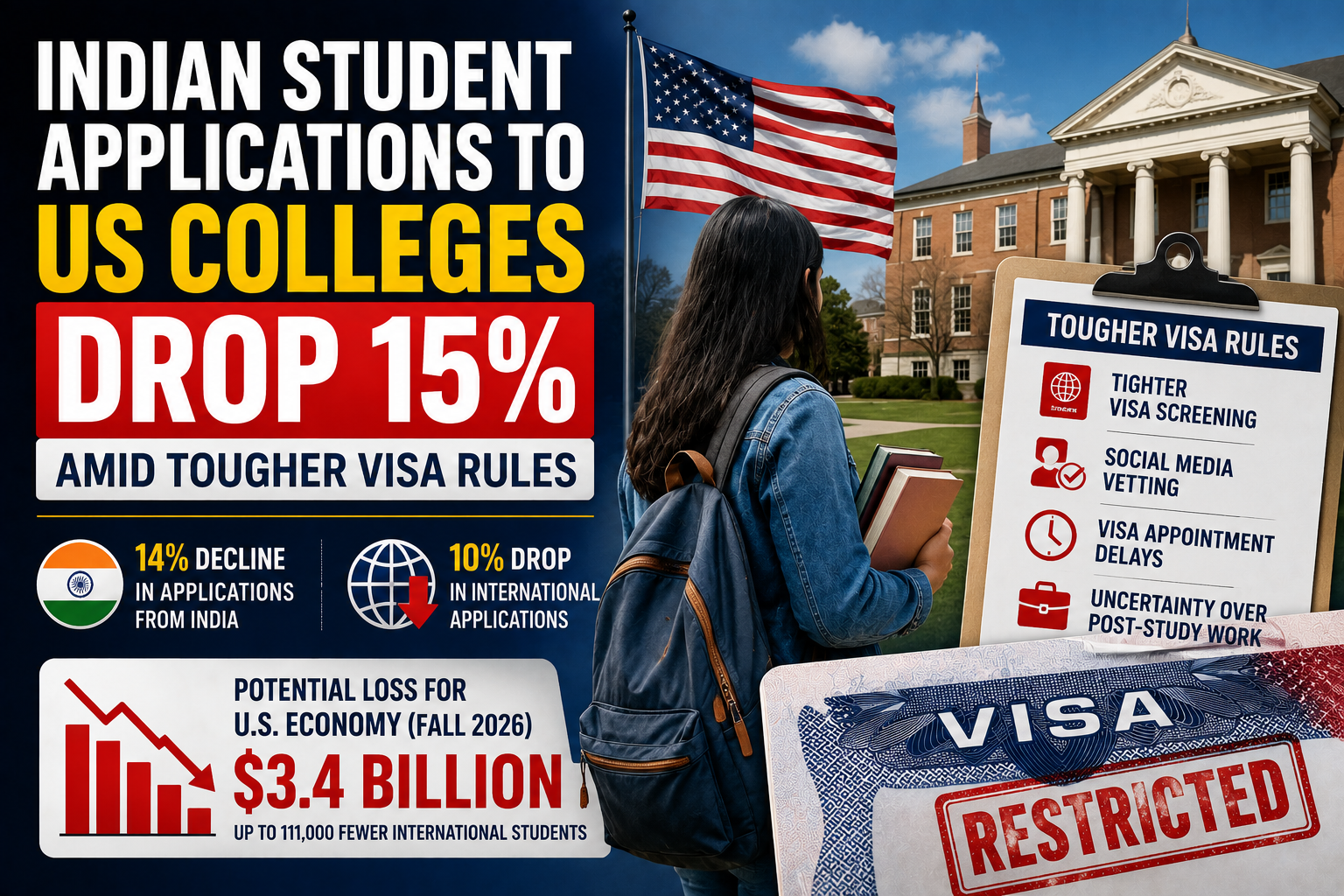

The number of Indian student applications to US colleges has fallen sharply amid growing uncertainty over U.S. visa rules and immigration policies under President Donald Trump.
New data from Common App shows that international applications to U.S. colleges declined during the 2025-26 admissions cycle, with applications from India falling by 14% through March 1 compared with the previous year. The latest Common App data therefore puts the decline slightly below the 15% figure reported in some coverage.
The decline comes despite overall application activity increasing in the U.S. The shift is particularly significant because India has become one of the largest sources of international students for American institutions.
The fall in Indian student applications to US colleges comes as students and families face tighter visa screening, appointment bottlenecks, changes to student immigration rules and uncertainty over post-study work opportunities.
Quick Highlights : Indian Student Applications To US Colleges
- International applications through Common App fell 9% year over year.
- Applications from India declined by 14% through March 1.
- NAFSA and JB International project up to 111,000 fewer international students in U.S. colleges in Fall 2026.
- The projected decline could cost the U.S. economy up to $3.4 billion.
- International students contributed an estimated $41.77 billion to the U.S. economy in Fall 2025-26.
- The U.S. has ended the long-standing Duration of Status system for F and J students.
- New rules will require eligible students who need additional time to seek a formal extension of stay.
- Concerns over OPT and post-study employment are adding to uncertainty.
Indian Student Applications to US Colleges Fall 14%
The latest Common App data provides one of the clearest indications yet that demand from Indian students is weakening.
Through March 1 of the 2025-26 admissions cycle, the number of international applicants using Common App was down 10% overall compared with the same point in the previous cycle. India recorded a 14% decline in applicants.
India has historically been one of the largest sources of international applicants on the platform.
The decline is notable because overall first-year application activity has remained stronger. Common App reported that domestic applicants and applications continued to grow, highlighting a widening difference between domestic and international demand.
This makes the decline in Indian student applications to US colleges more significant than a simple change in overall admissions numbers.
For Indian students, the decision to apply to a U.S. university increasingly depends not only on the quality of the institution but also on whether they can obtain a visa, enter the country on time and continue their studies without immigration complications.
Why Are Indian Students Rethinking the U.S.?
Several developments are contributing to uncertainty around American higher education.
The biggest concerns involve:
- Visa appointment availability
- Stricter applicant screening
- Social-media vetting
- Changes to student immigration status
- Travel restrictions
- Uncertainty surrounding OPT
- Potential changes affecting post-study employment
NAFSA’s latest Fall 2026 analysis says international student enrollment could decline by as many as 111,000 students. The organization estimates that the reduction could result in up to $3.4 billion in lost U.S. economic contributions and nearly 40,000 fewer jobs supported.
The analysis identifies declining application volumes, visa appointment bottlenecks and restrictive immigration policy changes as major factors behind the projected decline.
Indian Student Applications to US Colleges Could Affect Fall 2026 Enrollment
A decline in applications does not automatically translate into an equal decline in actual enrollment.
However, fewer applications create a smaller pool of prospective international students who can eventually enroll.
NAFSA and JB International’s latest projections estimate that international student enrollment could fall from a projected 1,168,602 students in Fall 2025-26 to between 1,056,884 and 1,104,912 in Fall 2026-27, depending on the scenario.
The upper-end projection represents a decline of more than 111,000 students.
For U.S. colleges that rely heavily on international enrollment, particularly graduate institutions, the potential impact could be substantial.
NAFSA says graduate-level enrollment declines are expected to be a primary driver of the economic losses.
U.S. Colleges Could Lose Billions From Fewer International Students
The financial impact extends beyond universities.
International students spend money on tuition, accommodation, transportation, food, healthcare and other services.
NAFSA and JB International estimate that international students contributed approximately $41.77 billion to the U.S. economy in Fall 2025-26.
Under their upper-range Fall 2026-27 projection, that figure could fall to $38.37 billion.
That represents a potential reduction of around $3.4 billion.
The projected decline could also put nearly 40,000 jobs at risk across the U.S. economy.
This is why the decline in Indian student applications to US colleges is not only an education story. It could also have consequences for universities, local businesses and communities that depend on international student spending.
U.S. Ends Duration of Status for International Students
Another major change affecting prospective students is the end of the traditional Duration of Status (D/S) system.
On July 17, 2026, DHS/ICE published a final rule ending Duration of Status for F, J and certain other nonimmigrants. Under the new framework, admission will be tied to a fixed period rather than allowing students to remain in the U.S. while maintaining status and making normal academic progress.
Students who need additional time beyond their authorized period may have to apply for a formal extension of stay through USCIS.
The rule does not mean that every student must finish a degree within four years. DHS has explained that the four-year maximum functions as a screening and enforcement mechanism, while students can seek extensions where permitted.
Nevertheless, education organizations have criticized the change.
NAFSA said the end of Duration of Status introduces additional uncertainty and bureaucracy for international students and exchange visitors.
Visa Processing Problems Are Adding to Uncertainty
Visa appointment availability has also become a major concern for international students.
NAFSA’s Fall 2026 research specifically identifies visa appointment bottlenecks as one of the factors contributing to the projected decline in international enrollment.
Students may receive admission from a U.S. university but still face uncertainty over whether they can secure a visa appointment in time to begin their programme.
This creates a difficult situation for both students and universities.
For applicants from India, where demand for U.S. education has historically been particularly strong, delays can influence whether students choose the United States or another destination.
Indian Student Applications to US Colleges Face Post-Study Work Concerns
Another important factor is what happens after graduation.
For many Indian students, the ability to gain professional experience in the United States is an important part of the overall value of a U.S. degree.
The Optional Practical Training (OPT) programme allows eligible F-1 students to obtain temporary employment related to their field of study.
Any changes affecting OPT therefore have the potential to influence student decisions.
NAFSA has urged the U.S. government to preserve OPT for F-1 students as part of its response to the projected international enrollment decline.
This is especially important for students choosing between the U.S., Canada, Australia and other major international education destinations.
India Remains a Major U.S. Student Market
Despite the recent decline, India remains an extremely important source of international students for American universities.
The United States hosted more than 363,000 Indian students during the 2024-25 academic year, according to the figures provided in the source material.
This large student population means that even a relatively modest percentage decline can translate into tens of thousands of fewer applications or enrollments.
The latest Common App numbers suggest that Indian student applications to US colleges are already responding to the changing policy environment.
Whether this becomes a temporary decline or a longer-term shift will depend on visa processing, immigration rules and how students assess the U.S. against competing destinations.
Could Indian Students Choose Canada, Australia or Europe Instead?
The United States is competing with several countries for international students.
Canada, Australia, the United Kingdom and European destinations have all become important alternatives for Indian students.
When students evaluate a foreign university, they generally consider more than rankings and tuition fees.
They also look at:
- Visa approval prospects
- Processing times
- Work opportunities after graduation
- Pathways to permanent residence
- Tuition and living costs
- Immigration stability
- Job-market opportunities
If uncertainty surrounding U.S. student immigration continues, some applicants may increasingly consider alternative destinations.
That could make the decline in Indian student applications to US colleges more than a one-year admissions trend.
What Indian Students Should Watch Before Applying
Students planning to apply to U.S. colleges should closely monitor immigration rules alongside university admissions deadlines.
Important areas to watch include:
Visa appointments: Students should check appointment availability before finalizing travel plans.
Student visa rules: F-1 applicants should understand the latest documentation and screening requirements.
Duration of Status: Students should understand how the new fixed admission framework could affect longer academic pathways.
OPT: Students planning to work in the U.S. after graduation should monitor any changes to post-study employment rules.
Travel restrictions: Applicants should verify whether their nationality or travel history is affected by any current restrictions.
What This Means for the U.S. Education Market
The fall in Indian student applications to US colleges comes at a difficult time for American universities.
International students provide significant tuition revenue and contribute to local economies.
NAFSA’s latest analysis estimates that a decline of up to 111,000 international students could reduce economic contributions by as much as $3.4 billion and put nearly 40,000 jobs at risk.
The organization has called for improved visa interview availability, continued access to OPT and policies that maintain the United States as an attractive destination for international students.
For U.S. universities, the challenge is therefore not simply recruiting students. It is also ensuring that admitted international students can successfully obtain visas and enter the country.
Key Takeaways Of Indian Student Applications To US Colleges
The decline in Indian student applications to US colleges is emerging as an important warning sign for American higher education.
Common App data shows that international applicants declined by 9% overall during the 2025-26 cycle, while applicants from India fell by 14% through March 1.
At the same time, NAFSA and JB International project that U.S. colleges could have up to 111,000 fewer international students in Fall 2026, potentially costing the economy up to $3.4 billion.
The United States has also ended the traditional Duration of Status system for international students and exchange visitors, adding a new layer of immigration compliance.
For Indian students, the combination of visa uncertainty, stricter screening, changing student-status rules and questions around OPT could increasingly influence where they choose to study.
The coming admissions cycle will show whether the decline is temporary or signals a broader change in international student demand for the United States.
FAQs : Indian Student Applications To US Colleges
Are Indian student applications to US colleges declining?
Yes. Common App data through March 1 showed a 14% decline in applicants from India compared with the same point in the previous admissions cycle.
Why are Indian students applying less to U.S. colleges?
The decline comes amid stricter visa screening, appointment bottlenecks and uncertainty around U.S. immigration and post-study work policies.
How many international students could the U.S. lose in Fall 2026?
NAFSA and JB International estimate that international enrollment could decline by as many as 111,000 students.
How much could the U.S. economy lose?
The upper-range projection estimates up to $3.4 billion in lost economic contributions and nearly 40,000 fewer jobs supported.
Has the U.S. ended Duration of Status for F-1 students?
Yes. DHS published a final rule ending the long-standing Duration of Status framework and moving to fixed admission periods for covered nonimmigrants.
Does the new rule mean every student must finish college within four years?
No. DHS has clarified that students who need additional time may seek an extension where eligible. The four-year framework is not an absolute requirement that every academic programme be completed within four years.
Is OPT still available to international students?
OPT remains an important employment pathway for eligible F-1 students, although its future and related policies are being closely watched as the administration reviews international student programmes.
Source : The Times Of India
Read About : US Visa Appointments Paused Worldwide 2026: Trump Administration Launches Global Consular Training