
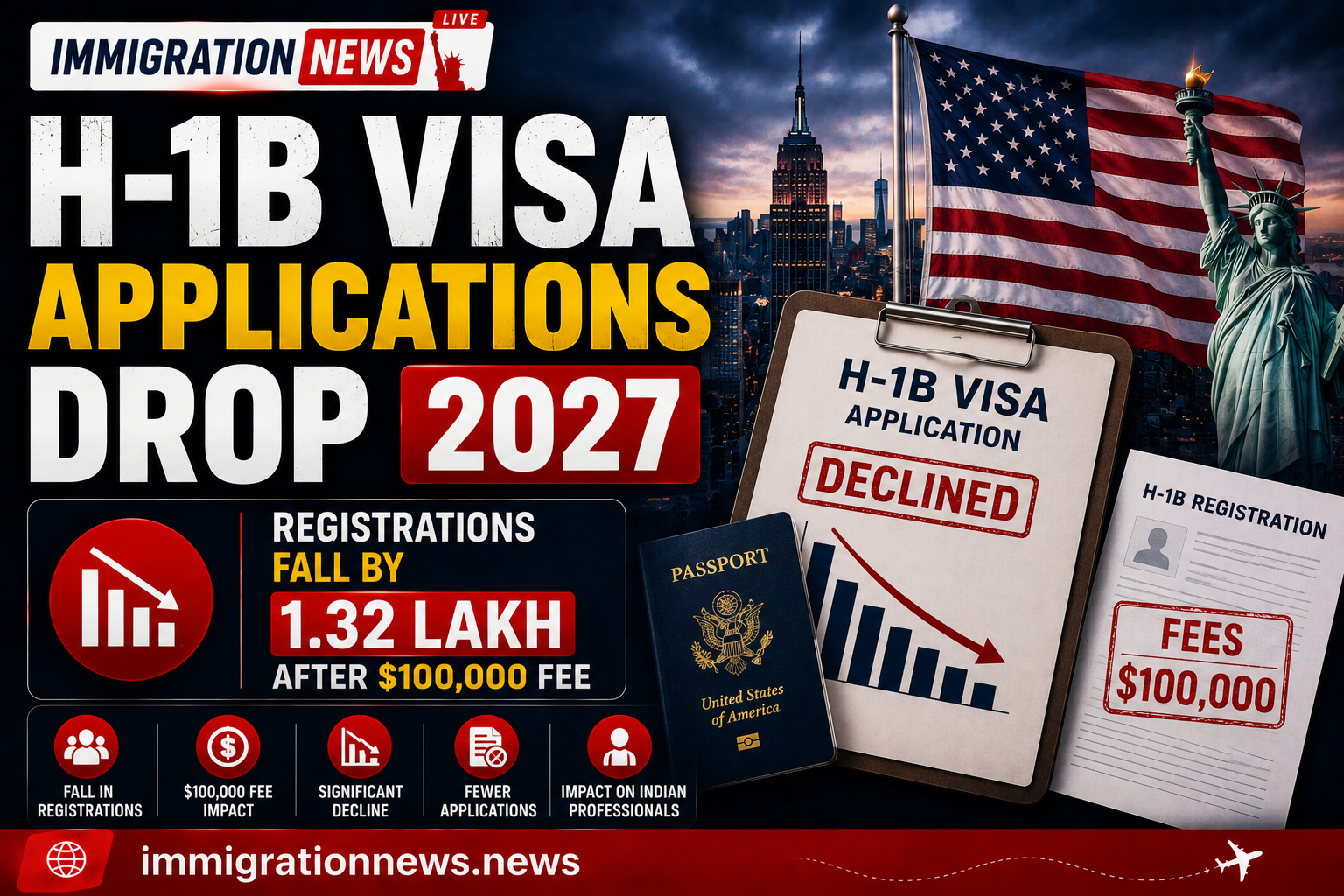
The Trump administration’s steep new H-1B fee has left a clear mark on this year’s lottery numbers. The H-1B visa applications drop 2027 has been sharp and unmistakable: registrations fell from 3,43,981 in fiscal year 2026 to just 2,11,600 for fiscal year 2027—a decline of roughly 1.32 lakh applications, or approximately 38.5%.
The primary driver behind this H-1B visa applications drop 2027 is the $100,000 supplemental fee that President Trump imposed through a proclamation signed on September 19, 2025, which took effect at 12:01 a.m. Eastern time on September 21, 2025. USCIS has confirmed the fee applies to new H-1B petitions filed for beneficiaries located outside the United States.
Quick Highlights : H-1B Visa Applications Drop 2027
- The H-1B visa applications drop 2027 saw registrations fall from 3,43,981 to 2,11,600, a decrease of roughly 1.32 lakh
- The $100,000 fee took effect September 21, 2025, replacing fees that previously ranged between $2,000 and $17,885
- USCIS reached the FY 2027 H-1B cap of 85,000 despite the steep decline in applications
- 71.5% of selected applicants held U.S. master’s degrees or higher, up from 57% the previous year
- Indian applicants continue to dominate the program, receiving roughly 70% of all H-1B visas
- A new Wage-Weighted Selection Rule took effect February 27, 2026, adding a second filter to the lottery
- Registration for the H-1B lottery is now conducted only once per year, down from two lottery rounds previously
The Numbers Behind the H-1B Visa Applications Drop 2027
USCIS confirmed the scale of this decline directly, stating that “properly submitted” registrations fell from 3,43,981 in fiscal year 2026 to 2,11,600 in fiscal year 2027—a drop of 38.5%. The agency characterized this decline as evidence that “the days of abuse in the program were over,” pointing to a shift in who is actually being selected under the revised system.
Despite this significant fall in registration volume, USCIS confirmed it had “received enough electronic registrations for unique beneficiaries during the initial registration period to reach the fiscal year 2027 H-1B numerical allocations,” including the advanced degree exemption known as the master’s cap. In other words, even with 1.32 lakh fewer applications, demand still comfortably exceeded the congressionally mandated cap of 85,000 visas.
Why the $100,000 Fee Triggered This Decline
The central factor behind the H-1B visa applications drop 2027 is straightforward: cost. Under the presidential proclamation, certain H-1B petitions filed on or after September 21, 2025, must be accompanied by an additional $100,000 payment as a condition of eligibility.
To put this in context, the total cost of filing an H-1B petition for employers previously ranged between roughly $4,535 and $17,885, according to industry estimates covering application fees, attorney costs, and training fees. The new $100,000 fee represents an increase of well over 100 times what many companies were previously paying—precisely the scale of increase reflected in the headline figures reported by Indian media.
The White House has defended the fee as a measure to ensure companies use the H-1B program to hire only highly skilled individuals who cannot be replaced by American workers, and to discourage use of the visa for lower-paid or entry-level positions. Critics, including the U.S. Chamber of Commerce, have pushed back forcefully—the Chamber filed a lawsuit in October 2025 arguing the fee would force businesses to choose between dramatically higher labour costs or hiring fewer skilled workers.
Who the Fee Actually Applies To
There has been considerable confusion around the exact scope of the new fee, and this has directly shaped the pattern behind the H-1B visa applications drop 2027. Government officials clarified that the steep fee applies specifically to fresh H-1B visa petitions for beneficiaries who are located outside the United States—not to existing H-1B holders or those seeking straightforward renewals.
This distinction explains an important nuance in the data: the decline in applications was concentrated specifically among candidates who would need to pay the $100,000 fee because they were applying from abroad. As one policy analysis put it, “the odds of winning the H-1B lottery simply improved this year because there were fewer applications for workers abroad, who would have to pay the $100,000 entry fee.”
A Second Filter: The Wage-Weighted Selection Rule
Compounding the H-1B visa applications drop 2027, USCIS also introduced a fundamentally new selection mechanism just before this year’s filing window. The Wage-Weighted Selection Rule took effect on February 27, 2026, replacing the previous random lottery draw with a system that prioritizes higher-wage positions in the selection process.
This dual impact—the $100,000 fee discouraging lower-wage applications from abroad, combined with a wage-weighted lottery favouring higher-paid roles—has visibly shifted who is actually being selected. USCIS data shows that 71.5% of selected applicants held U.S. master’s degrees or higher in the FY 2027 cycle, a substantial jump from 57% the year before, indicating that foreign students who studied in the U.S. and later applied for H-1B status are now representing a larger share of successful applicants.
The Lottery Structure Has Also Changed
Beyond the fee and wage-weighting, the H-1B lottery process itself has been restructured. Previously, USCIS conducted up to two lottery rounds in a single fiscal year if the initial selection didn’t fill the cap. Under the current system, only a single lottery is conducted per year, removing the second-chance selection round that had previously given additional applicants an opportunity if the cap wasn’t met initially.
USCIS has also indicated it upgraded its analytics and cross-system verification tools to detect overlapping entries and fraudulent submissions, following earlier fiscal years that saw widespread duplicate registrations submitted by the same beneficiary through multiple sponsoring employers.
Impact on Indian Professionals
The human impact of the H-1B visa applications drop 2027 is being felt acutely by Indian professionals, who have historically dominated the program. Indian nationals have received approximately 70% or more of all H-1B visas issued in recent years, based on annual USCIS data:
| Year | H-1B Visas to Indians | Share |
|---|---|---|
| 2021 | 2,18,000 | 74% |
| 2022 | 2,60,000 | 73% |
| 2023 | 2,88,000 | 73% |
| 2024 | 2,83,300 | 71% |
| 2025 | 2,83,772 | 70% |
Individual stories reported by Indian media illustrate the practical consequences of this shift. Reports describe Indian professionals facing months-long waits for visa interview appointments, some receiving dates up to 10 months out, forcing continued remote work arrangements from India while their status remains unresolved. Others have described H-1B renewals failing after years of employment in the U.S., with resulting job losses despite active job searches and multiple interviews. Some professionals have described difficulty finding equivalent salary opportunities in India after losing their U.S. positions, even when Indian job offers were available.
Major technology companies continue to hold significant shares of H-1B visa sponsorships, led by firms including Amazon, TCS, Infosys, Meta, Apple, and Google, according to recent company-level visa share data.
What H-1B Visa Applications Drop 2027 Means Going Forward
The H-1B visa applications drop 2027 reflects a program in the midst of structural transformation rather than simple contraction. While overall registration numbers have fallen sharply, the cap is still being met, meaning demand for H-1B visas among qualified candidates remains robust—it’s simply being filtered differently, favouring higher-wage positions and candidates with U.S. advanced degrees over the broader pool that characterized previous years.
For prospective applicants and sponsoring employers, this means the calculus around H-1B sponsorship has changed fundamentally. Employers must now weigh the substantial $100,000 fee against the value of sponsoring candidates from abroad, while candidates already holding U.S. degrees or already present in the country face a comparatively more favourable position under the current wage-weighted system.
Key Takeaways Of H-1B Visa Applications Drop 2027
The H-1B visa applications drop 2027 represents one of the most significant shifts in the program’s recent history, with registrations falling by roughly 1.32 lakh following the imposition of a $100,000 fee on petitions for beneficiaries abroad. Despite this steep decline, USCIS still filled the congressionally mandated 85,000 cap, confirming that underlying demand for the program remains strong even as its composition shifts toward higher-wage, U.S.-educated candidates. Indian professionals, who continue to receive the largest single share of H-1B visas, are navigating this transformed landscape amid longer visa interview waits, renewal uncertainty, and a fundamentally restructured selection process.
FAQs : H-1B Visa Applications Drop 2027
Why did the H-1B visa applications drop 2027 happen?
The decline is primarily attributed to the $100,000 supplemental fee imposed on new H-1B petitions for beneficiaries outside the U.S., which took effect September 21, 2025, alongside a new wage-weighted selection system introduced in February 2026.
Does the $100,000 fee apply to all H-1B applicants?
No. Officials have clarified the fee applies specifically to new H-1B petitions filed for beneficiaries currently located outside the United States, not to existing H-1B holders or standard renewals.
Did USCIS still fill the H-1B cap despite the applications drop?
Yes. Despite the roughly 38.5% decline in registrations, USCIS confirmed it received enough registrations to reach the full 85,000 cap, including the master’s degree exemption, for fiscal year 2027.
How has the H-1B visa applications drop 2027 affected Indian applicants?
Indian nationals continue to receive approximately 70% of all H-1B visas issued, though many report longer visa interview wait times, renewal difficulties, and job losses when H-1B status could not be maintained.
What is the Wage-Weighted Selection Rule?
Effective February 27, 2026, this rule replaced the previous random lottery draw with a system that prioritizes higher-wage job offers in the H-1B selection process, contributing to the shift toward higher-paid, more advanced-degree-holding selected applicants.
Source : Dainik Bhaskar
Read About : 18000 Indians Deportation USA: No Appeal, No Lawyer As ICE Raids Intensify

One thought on “H-1B Visa Applications Drop 2027: Registrations Fall By 1.32 Lakh After $100,000 Fee”